

Showing posts with label Water Conservation. Show all posts
Showing posts with label Water Conservation. Show all posts
Friday, May 25, 2012
Composting Toilet at Broadmoor Wildlife Sanctuary

Saturday, April 16, 2011
Forbidden Fruit!
Chris isn't going to like this. It's a pro-genetically-modified food blog! Looks like some good reading over there. I can already feel some of my previous opinions on the topic crumbling. . .
In that same vein, here is an article pointing out how very silly it is to use rain barrels. Sigh. . . it is so much easier to be uninformed and full of dogma.
Friday, October 15, 2010
Garbage Disposal = Wasted Water

By far the simplest way I have found to conserve water in my home is to avoid using the garbage disposal. Here is a device that takes perfectly potable water and transforms it instantly into waste water. Plus it adds more gunk to wastewater systems that is already, in many areas, so overloaded that they overflow into rivers when it rains. Plus the disposal burns fossil fuels in the process. Plus it wastes perfectly good composting materials.
(This is my last minute oh-shoot-I-forgot-that-today-is-blog-action-day post.)
Thanks to wikimedia commons for the image.
Sunday, August 1, 2010
State of the Yard Address


The miserable dry spell had put me in a torpor of neglect. I'm not going to list everything that I killed, because it makes me ill to think about. Time to move on. We've had some rain, it isn't so brutally hot, and the plants are growing again. I finally emerged from my summer dormancy and tore into the yard.

Gabe's Garden: scraggly and patchy up-close, but overall it's full of green stuff. The bee-balm needs to be moved out to the meadow. I don't know if I will stick to my original intent to make this area super toddler-friendly, since it fails at keeping Gabe contained. The biggest problem is that it's just so very dry up here in the front.

The big winners in Gabe's Garden are the tall grasses, especially paired with ground covers. Sadly, the native ground cover, common cinquefoil, Potentilla simplex, shriveled up during the drought. I'm hoping that those long roots have saved it from death.
The creeping thyme, on the other hand, is a bloody thug. That's it blooming at the foot of the grass, above. It came through the dry spell looking fantastic, and it is swallowing up a small clump of my native prairie dropseed, Sporobolus heterolepi, which I am not pleased about.

These clumps are Shenandoah switchgrass, Panicum virgatum 'Shenandoah'. They are getting wide enough to hug. I may divide them for use elsewhere.
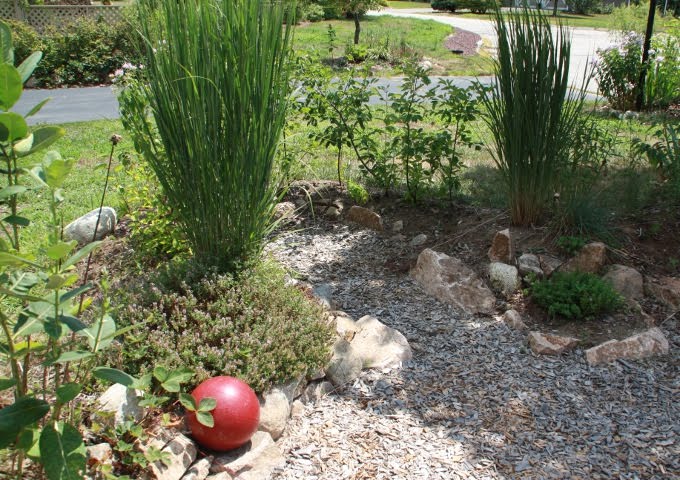
I still kick myself for losing the plant tags for these, but I'm pretty sure they are big bluestem, Andropogon gerardi. They stood unwilted and gloriously green through the drought. The switchgrass also performed admirably.
Have I mentioned that I water almost nothing up front? I hate the idea of dumping potable water on the ground. I would have neglected more of my new plants to death, had Chris not stepped in with the hose a few times.

That rockpile on the left is my new desert bed.

Among other things, the bed contains yucca, prickly pear, hens and chicks (not native, but I couldn't resist), flame flower (a West-coast native), false blue indigo, violets, and some fantastic volunteer spotted spurge.

In my absence, the lawn made serious progress in reclaiming my new beds here. I removed ten gallons of weeds. My many, many little creeping phloxes that I so painstakingly planted in a snaking border along the edge? There were massive casualties. The next time I am tempted to work with such puny pail-order plants, I'll be starting them in pots.

You can see the spent liatris there in the rear, in one big floppy mess. But I have to give them credit: they started this Spring as enie-weenie corms. I didn't expect them to flower this year at all. Maybe next year they will be more dense. I may not mind the flopping, if it looks like a giant purple octopus is climbing out of the dirt.
The nearer bed represents what happens when I walk into a nursery when I'm feeling weak. I don't know what half of the plants are. Most aren't native. There is bearberry in the mix, but I did it some serious damage by not watering during the dry spell. Wormwood has stolen my heart, but it is also smothering my birdsnest spruce. I'm learning so much about gardening, and I see the magnitude of what I have left to learn if I ever want to get this right.
Tuesday, July 20, 2010
Why grow a lawn?

This is the second article of mine that was published in the local paper, the Franklin Country Gazette. My third article may be out in this week's paper, but I don't yet have a copy.
Why Grow a Lawn?
In my childhood, I lay on the grass of my Virginia lawn, picking dandelions, four-leaf clovers, and bluets. Now it is common to see signs warning that the grass is unsafe even to walk on, placed sidewalks by companies who want to convince us that a poisonous and homogonously flower-free lawn is somehow good for our children.
Prior to the twentieth century, the typical American yard was a mix of gardens and packed dirt. The clipped lawn originated in England, where it was a status symbol displayed by those who could afford to not to devote all of their land to livestock or farming. Those green power statements were watered with England’s soggy weather, mowed with scythes, and weeded by hand.
Wealthy Americans sought to emulate the practice, but gardeners are expensive, and neither the dry North American climate nor the native grasses were suitable for lawns. It took the introduction of mass-produced human-pushed reel lawnmowers, subsidized water, and garden hoses to make lawns a possibility for the middle class. And, oddly, the USDA had a hand in solving the grass “problem”: in 1915 they teamed up with the US Golf Association (golf itself originating in Scotland, a land of open grasslands) to find grasses that could withstand the North American climate. The final nail in the lawn-conformity coffin was a pamphlet circulated by the American Garden Club which stated that lawn was to be "a plot with a single type of grass with no intruding weeds, kept mown at a height of an inch and a half, uniformly green, and neatly edged."
It takes a barrage of chemicals to emulate English landscape, and these chemicals are dangerous to us and to our environment. Canada has banned all weed-and-feed lawn products. Here in Franklin it is illegal to spread pesticide, herbicide, or lawn fertilizer closer than 50 feet to a wetland. (And yet even though so many of us live adjacent to wetland, we are still solicited by lawn-chemical companies.)
For those who simply cannot do without lawn, there are organic methods of lawn-care, such as using old-fashioned push mowers. Corn gluten can be used as a pre-emergent herbicide. Lawn that is mowed higher is more healthy, and therefore more able to out-compete weeds. Clover can be added to contribute nitrogen to the soil, and newer varieties of grass require less water or no mowing at all.
For those who don’t care to obsess over having their lawn be an unblemished shade of green, however, there is an easier option. In a recent New York Times article, author Robert Wright suggests that we continue to grow and mow our existing lawns, but leave the chemicals out, and let the weeds back in. “Next time you see a yard full of sprouting dandelions,” he writes, “note that they look remarkably like things we call ‘flowers’.” Activities that require lawn can just as easily be played in the presence of weeds.
What else can we do? To the aesthetically-minded, a yard is a canvass to be painted with flowers and foliage. To environmentalists, a yard is a place to recreate habitat. To those who like a good meal, a yard is the place to grow vegetables. Alone or in concert, all of these approaches can bring our yards back to our not-so-distant American roots and away from the idealized indusrial lawn.
For those trying to recreate habitat, a good option can be to grow a backyard meadow. Meadow needs to be mowed only once a year, needs no water, no herbicides, no pesticides, and no fertilizer. There are many flowering plants that inhabit meadows, and the local wildlife will thank you for the food and shelter that your meadow provides.
The best way to grow a meadow, from a habitat perspective, is to kill the existing grass and replace it with North American native plants. An example of such a meadow can be seen at Garden in the Woods, in North Framingham, and during the growing season, its flowers are a wonder to behold. But a lawn left to grow tall can still be an environmental improvement. At Idylbrook Field, in Medway, mowed paths meander through a heady mix of native and non-native plants.
I am experimenting with such a meadow in my own yard. In theory, it will be kept tidy by maintaining a mowed strip around the edge. Last Autumn I sprinkled the area with the seeds of native meadow flowers and grasses. Already I can see milkweed growing. And I have an emergency backup: if the meadow doesn’t turn out to my satisfaction, I can mow it down and call it a weedy lawn once again.
Monday, July 12, 2010
Rain!

Finally! What was that, a month of no rain?

This is the rainbarrel overflow station in action. Two overflow hoses go into the watering can when it isn't being used, and the can sits on rocks that keep it tilted to pour the overflow into the bird bath.
It took less than fifteen minutes for the rain barrel to fill and overflow. That's a hundred gallons in a very short time. No wonder the flooding was so bad this Spring. Just think of all the water running off of all those roofs and parking lots.

There is so much water pouring out, that one hose is missing the can entirely, and the can is still overflowing from the side. Yay water!
This was rain from Saturday. Last night we had another deluge, and this morning is blissfully foggy.
Friday, July 9, 2010
Rain Barrel Water Conservation
 Our stacked rain barrels hold a total of 108 gallons of water when they are full, and at the start of this dry spell we've been having in Franklin they were full. We have them setup so they also collect water that our air conditioning unit produces every day, giving us a steady inflow of several gallons. At this point we're down to the last twenty or so gallons in the tanks, which will hopefully fill up again if it rains tomorrow.
 The water barrels have been the only source of water for my borrowed earth boxes which combine to consume around 8-9 gallons of water a day. Those nearly seven foot tall tomato plants are thirsty beasts in this heat. We probably use another couple gallons watering the plants at the water station and Michelle's seedlings/transplants. With the additional input from the air-conditioner we've easily saved two-hundred gallons of water use that would have otherwise come out of the tap.
If everyone in Franklin took advantage of similar rain barrels to water their gardens with during this drought we could have combined to save a little over 7,500,000 gallons of water, which surely would have helped our over-burdened aquifer!
 Many rain barrels I've seen only have a spigot a half a foot or so up from the base of the barrel, effectively cutting off many dozens of gallons capacity. While our rain barrels from Arid Solutions weren't cheap, they are very well designed, with multiple output spigots at different levels and overflow spigots at the top. The main source of water comes out of the base of the barrels through the green hose.
 The fact that the spigot comes out the base of the barrels means we have access to all the water in them, and the other important aspect of our water station is the hose drops several feet to where we access it. This differential in height gives us great water pressure for a rapid flow. Filling a gallon jug takes about twenty seconds or so through this filling method, while using the brass tap mounted higher on the barrel takes much longer. If you do get a rain barrel consider placing it where you have a natural incline to take advantage of, or put it up on cinder blocks to give it a height boost.
 The first year we had the rain barrels we didn't use them as much as we do now. Adding the hose that comes out of the bottom with a valve on the end of it made all the difference. It lets us take the hose where we want it and turn it on/off where we are. The hose and the valve cost a little extra, but combined with the height differential they make a world of difference in accessibility and flow rate over the generic spigot out of the side of the barrel. Happy conserving, and please everyone do a rain dance! ;)
Monday, July 5, 2010
Gabe's Garden Update


Just some quick photos of the front. It's trial-by-fire time for my plants. Two weeks of blazing sun and no rain are making even the most weedy natives wilt, and I rarely water. The cactus and the native grasses are the only plants that seem to be enjoying life right now. I have determined that I'll have a perfect garden by the time I'm a little old lady.
Wednesday, March 3, 2010
This makes me angry!
Some responsible citizens in Orange County are being sued by the city for removing their lawn to save water. You can lodge a complaint with the city on their behalf here.
Sunday, January 31, 2010
Our Stylish Rain Barrel
Our town periodically offers rain barrels for sale, which is a great way to encourage water conservation. There's no sense in sending rainwater down the storm drains and then watering one's plants with potable water. Still, the barrels they sell are a blue color that could only in good conscience be hidden in a back yard. Even our trash cans aren't so hard on the eye.
But Chris and I were both longing for a rain barrel, so we did some research, and he found these: a stacking pair of plastic containers that are both more stable than a conventional barrel (and thus safer in a yard with a curious toddler), and that came in a color which matches our house. They were Chris's Christmas gift a year ago, and this past growing season, they made a surprisingly tasteful addition to our front flower bed.

Can you see the container, there in front of the house, on the right? My mother, whose aesthetic sensibilities surrounding homes will cause her to go on red alert in the presence of an over-full compost bucket waiting on the kitchen counter to be taken to the garden, walked right past these barrels and didn't see them.

You may notice that the barrels bulge a bit on the bottom right. That's our fault; we did not do a good enough job of levelling the ground where they sit. The barrels are tucked into the garage for the winter now, and in the spring we will rebuild the foundation.
Also our fault: when assembling the barrels, we neglected to follow the instructions and screwed the two containers together much too tight, ruining the connecting piece. But I got in touch with Arid Solutions Inc., the manufacturer, and I'll be damned if they weren't the most exceptionally helpful company I've ever worked with. They went above and beyond the call of duty in assisting us get the barrel fixed.

Here's what the barrels look like from the side. The right-hand hose is for watering the raspberries, but we ended up more often just filling the watering can at the spigot in the front. The short hose on the left is the overflow. When it rains and the barrel is full, the extra water pours into the birdbath, which is a far more tasteful and safe way to offer water to the wildlife than our previous orange bucket.
The water management in this spot needs more work, because during heavy rains the hose sometimes can't manage all the water, and we end up with a puddle in the garage. Again, something to fix in the spring.
I never did see any animals at the birdbath, but obviously the chipmunks like the location, because that's where all of my strawberry tops ended up. I have also seen snake-skins here, and wasps live in the sand between the rocks. Given how active the wildlife is in this little corner, I may have to overcome my tendency to kill potted plants, and include some here again next season.
Wednesday, June 17, 2009
An Environmental Outlaw Turns Herself In

This is why I have been feeling so down about the garden lately.
Town of Franklin Municipal Services Guide: Message from the Conservation Commission
“. . .The Conservation Commission would like to remind all residents that live within 100 feet of a wetland or within 200 feet of a stream or river to talk with a Conservation Agent prior to undertaking any activity that requires disturbing soil; pruning or cutting of trees or brush; or building of any structure within these areas. . . Failure to obtain a permit prior to conducting work within Conservation jurisdiction may result in an Enforcement Order requiring the work to stop and a fine of $300/day under the Town’s Conservation ByLaw. In addition, and Enforcement Order could result in fines from the State of $25,000 per day. . .”
Oh shit.

Dear Conservation Agent,
I am a homeowner in Franklin, and I am an avid organic gardener. I have been working to include more wildlife-friendly features, native plants, and water-conservation methods in my yard. It has also come to my attention that I may have inadvertently violated our wetland laws. I need some help to determine if I have done something that I shouldn’t have, and if so, what I must do to put things right again.
Our property includes protected wetlands along one side. Extending in from the protected area is a wide swath of perpetually muddy forest floor, populated primarily by skunk cabbage. I built a short path into this area using sand excavated from elsewhere in the yard. I also dug a hole in the mud in one spot to make a tiny frog pond, and I trimmed branches from a poison sumac that were overhanging the lawn and posing a hazard to visitors.
My intent with this activity was to be able to show my family and friends the beauty of our wetlands, so I am quite embarrassed to discover that I may have done something harmful. I should have checked with you first to see if I needed a permit. I am now deeply afraid that I will be fined for what I did, because I can’t afford to pay a large fine.
What do I need to do to undo any harm I have done and to be in compliance with the law?
Thank you.
Embarassed Homeowner
Embarrassed Homeowner -
Thank you very much for your responsible attitude and willingness to make this right. I will talk with the Commission and seek their input on what to do next. In the mean time I will provide you with the permitting options as well as a few facts about wetlands.
Wetlands do not have to have water on the surface in order to be considered a wetlands. We use a three prong approach to determining the extent of a wetlands. They are 1) more than 50% wetlands vegetation, 2) soil morphology and 3) ground water depth. By combining all three variables we come up with a line that represents the extent of the wetlands. However, we also have jurisdiction on the property that is located within 100 feet of wetlands and 200 feet from a rivers bank (these are called buffer zone areas). If the area is located within the wetlands or within either buffer zone, you need to obtain a permit from the Conservation Commission prior to starting work.
There are four (4) different types of permits the Conservation Commission can grant. I will discuss them in the order of least difficult to fill out and be permitted to do to the most difficult to fill out and the hardest to obtain.
1) Minor Buffer Zone Activity.
2) Request for Determination.
3) Abbreviated Notice of Resource Area Delineation.
4) Notice of Intent
We can discuss permitting options after I speak with the Commission. You will have to let me know what is you name and address. If you fail to provide us with the requested information the Commission will take a legal steps required to find out who you are. It will be much better if you provide the requested information. As far as fines are concerned I would expect only a small fine of around $75. You can always request that the fine be waived especially since you came to us as opposed to us finding out from someone else. I will be in touch next week.
Take care,
[name withheld to be polite], Agent
Franklin Conservation Commission.

The conservation agent will be paying a visit to our yard soon to take a look. He sounded friendly and sympathetic on the phone. I am greatly relieved at the small size of the fine he mentioned. I am paranoid that he might find something massively in violation in our yard, but I am also relieved to be getting this over with. And there is a small part of me hoping that he will be impressed with our gardening efforts, as well as my willingness to work with him.
Wednesday, May 20, 2009
Yard Montages
The first flowers of Spring are exciting, but what really moves me is when everything goes green. Here is our front yard shot from a few locations, and patched together from multiple photos. This does make the yard look wider than it actually is, but it is a big yard!


I shot these photos last weekend when it was too wet to mow. The gra. . . I mean weeds. . . are getting high enough to pose a tick threat, so when we got home today, Chris mowed a path to the garden and out to the woods for me, so that we aren't cut off until the weekend.
I am beginning to lust after neat, mulched walks edged with flowers. Grass makes me squeamish now.
Just this afternoon I was reading through the blog of a kindred clueless gardener. He has now had Lymes disease three times, and practically wears a haz-mat suit into his garden. And here I thought I was just being paranoid by always tucking my pants into my socks!
But back to moderately more happy thoughts. . . if you look closely, you can see Chris' birthday present there in between the deer-munched yew and the unwanted-but-can't-afford-to-replace-yet invasive burning bush. Here is a close-up:

This is a stacking rain barrel made by Arid Solutions, Inc. So far, it's been so-so. It matches the color of the house, which is a big plus; and we never seem to run out of refills for the watering-can from it. However, in our excitement, we neglected to follow the instructions that said "assemble on a flat surface" and "don't force it, dummies!" We screwed it together crooked, and too tight to undo, so now the connecting parts are trashed, and only the bottom tank holds water. We are waiting to hear back from the company about whether they can sell us replacement connecting parts.
Sunday, January 4, 2009


Saturday, November 22, 2008
November
I thought I might continue to dig today, but the ground is hard, and the air is bitterly cold.

Just last week I saw frogs swimming in our tiny pond.

Without leaves, the back yard seems wide open.


Just last week I saw frogs swimming in our tiny pond.

Without leaves, the back yard seems wide open.

Tuesday, November 18, 2008
Getting Colder
We wake up to frost and ice some mornings now.


We’re due to get our first snow flurries soon.
The strawberries have been tucked in for the winter.

Along the base of the front bed, I planted crocuses, creeping thyme, and wild violets.

To my surprise, the alyssum is still blooming, and the Swiss chard is still growing. And the saffron crocuses are coming along nicely.

Saturday, September 13, 2008

Subscribe to:
Posts (Atom)


 Posts


