
In other news, I stopped by the American chestnut orchard at Idylbrook, and most of the trees have been marked with blue ribbon. Those, I suppose, are the losers in the breeding competition. I need to get out there and photograph them before they are cut down.
Showing posts with label Chestnuts. Show all posts
Showing posts with label Chestnuts. Show all posts
Wednesday, August 24, 2011
I should have mentioned. . .
A reporter at a local news source got word of Unicorn 1's discovery and pollination, and gave me a call right before I took off on vacation. Heh. . . my first time being interviewed, and I happened to be about to set foot in the shower. I was answering questions while wearing a towel, and trying and failing not to laugh as my naked son climbed in and out of suitcases.

Friday, July 15, 2011
Success!

Lookee!

Unicorn One has been pollinated! See the paper bags? There are 11 of them that I could see.

The nuts under these bags will be collected when ripe, and used to grow the next generation of Restoration Chestnuts. There are somewhere between 11 and 44 pollinated female blossoms in there, each blossom could make up to three nuts. So that's as many as 132 future trees here!

These nuts are developing higher on the tree. I don't know if these nuts are viable for growing new trees.
This is the American chestnut tree growing next to the Upper Charles Trail in Milford, MA. It turns out the Friends of the Trail group had already spotted the tree, but I guess they didn't know to pass the info along to the American Chestnut Foundation.

I feel like I have done something deeply good for humanity and the environment. :) Someday the wilderness will be full of these trees again, and I have now played a small part.

I feel like I have done something deeply good for humanity and the environment. :) Someday the wilderness will be full of these trees again, and I have now played a small part.
Tuesday, June 28, 2011
More Unicorns

After having stumbled across a blooming American chestnut quite by accident, I was inspired to go hunting for more. I knew that the Nature Trail and Cranberry Bog at Patriot Place was full of chestnut regrowth, so it seemed like a logical place to search. While there were lots of chestnuts, tall ones even, along the wooded trail, they appeared to be too busy trying to reach sunlight to produce flowers. So I tried the parking lot.
And I lucked out - not one, but two flowering American chestnuts!

As a joke, I have been telling my friends how I am hunting for unicorns. So, I am giving my chestnut finds unicorn designation numbers. Let me introduce you to Unicorn 2 and Unicorn 3. (You've already met Unicorn 1.)

Unicorn 2 is a scraggly shrub, no more than 15 feet tall. She has some dead twigs, with withered leaves on some. Other dead twigs are bare.

The catkins are scattered unevenly about the tree. Most, from what I could see, only had male flowers.

More catkins. Click to see the image enlarged. I'm not seeing any female flowers here.

This one has female flowers, though.

These three female flowers were the only ones I was able to see, even when I zoomed in on my photos.

This tree is a shrubbery of suckers. But it isn't blocked by undergrowth, the ground is reasonably flat around it, and it would be easy to get a ladder here.

The main trunk measured in at 4 inches in diameter, at approximately 4.5 feet from the ground. But as you can see, there is blight damage.

Here are those dead twigs I had mentioned.

Lastly, here is the tree with each visible catkin-bearing branch marked. There are 30 marks. But I'm guessing that most of those clusters don't have female flowers.

Onward! Here is Unicorn 3, to the left of a light post. This one is maybe 25 or 30 feet tall. At first glance, it didn't appear to have flowers at all.

Male flowers.

More male flowers.

More male flowers. And overall, the catkins on this one are a lot smaller and . . . less enthusiastic?

Are these catkins just a bit more immature than the previous trees? I don't know.

The trunk is large, but I couldn't get to it to take a measurement. Nor could I see the ground. It may slope downward in there. And this looks like blight damage.

The thicket is too dense to casually walk up to this tree. I guestimate a diameter of 17 inches.
Higher up the tree.

I would mark flower clusters on this tree, but I can't even see them when I zoom into the photo. Click the image to enlarge.
Chris joked that I'm having such luck finding these unicorns because I have a virgin maiden along. Har har har.

Lastly, here is a map of the area, thanks to Google.
Friday, June 24, 2011
A Blooming Chestnut!

While I was out with a friend walking the Milford Section of the Upper Charles Trail, we stopped so that I could nurse Kaylee. While shooing away mosquitoes, I noticed that there was a lot of American chestnut regrowth in the area. And then I saw that the largest of them was covered in catkins.
Kathy Desjardin at the American Chestnut Society has confirmed from a photo I sent that this is an American Chestnut, and that it has female flowers, which means that if they can get permission in time, and if it has enough female flowers to be worth their while, they can pollinate this tree as a part of their breeding program.

The bike path starts from a parking lot off of Dilla Street, at Louisa Lake.

This is the gate leading to the path. (And a note for the folks at TACF, the path is large enough for a truck. Turning the truck around in there would be difficult, however, and the gate is locked.)

The tree is here, by a "pull off area", less than a mile down the path. The backpack on the path marks the location of the tree.

Here it is, by the end of the fence, with my son as scale reference.
The tree is ten or fifteen feet from the path, down an incline, and surrounded by raspberry brambles and other plants. (But there was no poison ivy that I could see, at least.)

I was wearing Kaylee at the time, so I couldn't safely get in there to make a measurement or assess the health of the trunk. But I could see this much from the path.

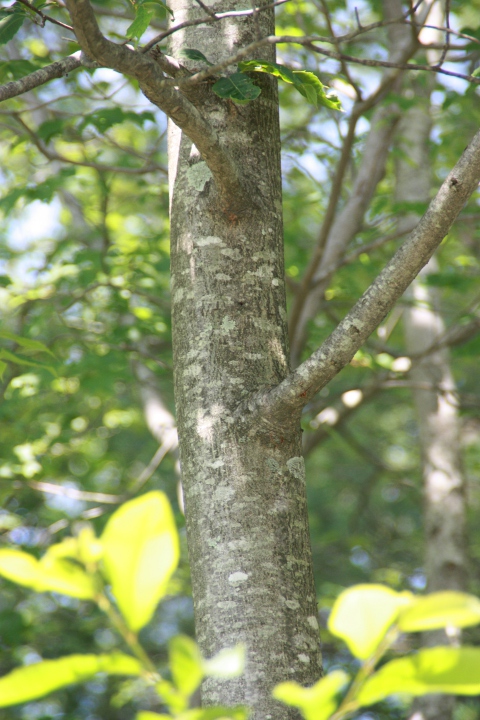
Here is a view showing a slightly lower segment of the trunk. I don't know if that vertical mark is a feature of chestnut bark, or evidence of blight.
Fiddling around with a piece of string and a ruler, I guestimate the diameter of the tree at 4.5 feet from where I think the ground is to be about 16 inches.

Kathy was curious if we could figure out from my photos how many nuts the tree is making. I couldn't see female flowers on all of the clusters of catkins. . .

. . .but this one has four.

Here is a close-up of the female flowers. Each one will become a nut.

This one has four as well.

Here is another shot of the tree.

This is the same photo, cropped in close. I have placed a purple dot at the location of every catkin cluster I could see in the photo. There are about fifty dots. So, my conservative estimate would be fifty nuts. More wishfully, two hundred. I don't know how many potential nuts would make this tree worth the TACF's time, since pollinating a tree requires a large truck and someone with a lot of patience.

This is the remains of another American chestnut tree nearby. This one also made it to a good 20 feet tall before it was killed by the blight. The live one is 25 or 30 feet. Hopefully it lasts a few productive seasons before dying.
I never thought I would see an American chestnut blooming in the wild, much less find one myself. I don't have adequate words to describe how I feel right now. I had to tell my friends that this is like seeing a unicorn.
Tomorrow I plan on going to the Cranberry Bog at Patriot Place, because there is another American chestnut there, too, that I spotted last month. It is of a similar size, and appears to be suffering from blight. I'll get some photos for TACF. Hopefully it is blooming, too.
OMG

I found an American chestnut in flower. The tree appears to my untrained eye to have female flowers. Posting this for the TACF folks. . . more photos of the tree and location coming shortly. . .
Thursday, April 7, 2011
American Chestnut Article
Whoops! I meant to post this some months ago. This is my Garden Geek article on American chestnut trees which appeared in the December edition of the Franklin Country Gazette.


The American Chestnut
At Idylbrook Field in Medway, an unmarked path leads through a meadow of wildflowers into rows of cultivated trees. A layman could easily overlook the site as a run-of-the-mill orchard if not for the sign explaining that these are Castanea dentata - American Chestnut.
If the words “American chestnut” don’t give you goose bumps, let me tell you why it should. Schoolchildren revere pandas and elephants and tigers, and most Americans have a soft spot in their heart for our bald national bird. The American Chestnut has similarly been pushed to the brink of extinction.
Castanea dentata is arguably more important a species than any of the charismatic fauna that top the food chain. A scant hundred years without American chestnuts has caused us to forget that East-coast forests used to be chestnut forests. These were New England’s sequoia. American chestnuts could average five feet in diameter and a hundred feet in height, but historic photos demonstrate that they grew much larger than that. On that sign in Idylbrook, a black-and-white photo shows three lumberjacks seated inside of the gash they have made in one tree - a trunk which is easily fifteen feet in diameter.
The chestnut was immensely valued for its wood. The trees grew fast and straight, producing hard wood that was so highly resistant to rot that there are still original chestnut barns standing. In Appalachia, they were known as “cradle-to-grave” trees, because the wood was used for everything, from fences to buildings, to cradles and coffins.
Unlike oak, which only produce a reliable crop of acorns every two to four years, American chestnuts produced copious yearly quantities of nuts. Not only were these a staple in the diet of Native Americans, but bear, elk, deer, turkey, doves, squirrels, blue jays, mice, and passenger pigeons were just some of the native animals that depended on the American chestnut to get through the winter. And Castanea dentata was a food source to hundreds of species of insects, which in turn were food for birds.
It was a fungus, accidentally introduced with an Asian chestnut, that killed the American chestnut. In 1904 the epidemic was first spotted at the Bronx zoo. This blight would kill a tree by forming cankers on the trunk that blocked the flow of water between roots and leaves. The fungus spread from tree to tree at a rate of fifty miles a year. The lumber industry reacted with a panicked spasm of logging that likely contributed to the loss of the few trees which would have survived the epidemic.
Within forty years, up to four billion American chestnuts were dead. Both North America’s ecosystem and the logging industry were irrevocably altered. The one paltry good came out of the tragedy was the passing of the Plant Quarantine Act of 1912, which has slowed, but not stopped other plant pathogens from wrecking havoc on other vital American plants.
There are now so few Castanea dentata remaining, numbering in the hundreds, and they are so widely dispersed, that without human intervention they would surely be the last generation of American chestnut trees. But enter the American Chestnut Foundation. This organization has been working for decades to raise awareness, identify and protect surviving chestnut trees, and most importantly, breed a hybrid American chestnut that retains just enough Chinese ancestry to be resistant to the blight.
To this end, TACF has hand-pollinated many of the remaining trees, carefully tending the resulting generations in test plots up and down the East Coast. This brings us back to Idylbrook. Here, six hundred chestnut trees stand in the sun, looking innocently healthy and inconspicuous, as if they were just another common tree.
The eldest of Idylbrook’s chestnuts have matured, and have begun producing nuts. In an act that seems cruel at a glance, this year these trees were deliberately exposed to the blight. At some point in the future, the three or four of the healthiest trees out of a hundred will be chosen as breeding stock for the next generation. The rest will be removed from the gene-pool with a chainsaw.
Someday American chestnut will again be a major part of both the logging industry and the ecology, thanks to the long-term efforts of TACF. This tree is a vital part of America’s landscape, and at Idylbrook, history is in the making. I urge you to go for a visit before the next round of culling takes place, and then get involved. Become a member, donate, or volunteer: volunteers will be needed when the trees are cut down, and are needed on a continual basis for weeding, watering, and other maintenance work. More information can be found at acf.org, and at masschestnut.org, which is the local chapter of TACF.
Thursday, December 23, 2010
Are you an artist?

The American Chestnut Foundation is looking for artists to sell American chestnut-themed art through their website! More information can be had here.
I used to be an artist. Now I admire art made by other people!
Since he likes owls so much, I commissioned a piece of art for Gabe from a friend and former coworker, Sean Murray. I asked him to do something with an owl as the central element, and also including a little boy, a little girl, and an American chestnut leaf and nut. Check out what he came up with!

I would love to see his work sold through the TACF. You can see his other paintings, and buy prints, here. The print quality is just amazing, and boy does he have a great sense of humor! Go look, and support an actual artist!
Tuesday, December 7, 2010
Nut Update
Five of my indoor chinkapins have sprouted leaves! And all of these are in separate containers: three in milk jugs and two in soda bottles.
I was diagnosed with placenta previa and told by the doctor to take it easy - no exertion in the garden, and no lifting anything over 25 pounds (including my son). Well, feeling bloated around the middle makes me disinclined to do a dang thing outdoors anyway, so this level of gardening is absolutely perfect right now. Wait. . . peek. . . wait. . .
I was diagnosed with placenta previa and told by the doctor to take it easy - no exertion in the garden, and no lifting anything over 25 pounds (including my son). Well, feeling bloated around the middle makes me disinclined to do a dang thing outdoors anyway, so this level of gardening is absolutely perfect right now. Wait. . . peek. . . wait. . .
Sunday, November 28, 2010
Chinkapin versus Chestnut

A second chinkapin seedling has popped up today! I swear, they must make a "sproing" noise when they emerge, the way they magically go from nothing to three leaves.
Anyway, when I got my nuts planted (har de har, I do love talking about my nuts!) I reserved a few for a photo-op and taste test. So, here they are, featured with a penny for scale-reference, and some imported chestnuts.
As you can see, there is a good reason that chinkapin aren't a part of our modern diet: they are tiny. Though I suppose size restrictions don't keep anyone from eating rice, so there goes that argument. More likely is that nobody ever focused on finding a mechanical means of harvesting and shelling them, leaving them to languish in the forgotten realms of so many other amazing foods that never make an appearance at grocery stores.
Cute, aren't they? Yes, you say, but what do they taste like?

They taste fegging delicious! The meat is soft and smooth, like acorn, if you happen to have ever eaten acorn, har har. And sweet. I can't compare them to the chestnut flavor, alas, because my fancy expensive imported chestnuts turned out to be all dried up. That big yellow brainy thing is the chestnut nut-meat. They were sweet but too tough to bother with raw, and when I tried roasting them, they turned into toothbreakers. So, not a fair comparison.
Both chinkapin and chestnut have a shell that is more like leather than wood. Again, much like acorn. This makes chestnuts versatile, because they can be cut open with a knife. Perhaps that is what I needed to try with the chinkapin. As it turns out, they are too small for a nutcracker to open. Using the extreme wrong end of the cracker, I sent a few nuts zinging across the living room, and painstakingly squashed the remainder. You can see the slightly mangled nutmeats, above. A board and a rock would have been faster, and mangled them just as thoroughly.
After eating those, I cracked open a pecan. Three things struck me. "Wow, this shell sure is a noisy brittle pain." "This nutmeat is giant!" And "this tastes like sawdust." There actually was enough moist sweet flavor in those smaller-than-peanut chinkapins to put pecans to shame. And I love pecans.
Fascinating!
Saturday, November 27, 2010
Surprise!

Germination! Here is my first confirmed Allegheny chinkapin tree.

Ironically, this little guy is growing in the container that I let Gabe set up. I had given him the small nuts, and the molding ones, to keep him busy while I got the rest potted. There may be a dozen in here. But by the way the exposed roots looked, and the sorry quality of the nuts, I had been sure they were dead! I guess they like the shallow and cluttered conditions. Perhaps it reminds them of the way they would collect naturally on the forest floor.
My next challenge: did I give these plants enough room to grow between now and December? I only left a few inches of each container unfilled with dirt.
Better that I have to deal with overcrowded greens than no greens at all, I suppose!
Tuesday, November 23, 2010
Waiting for my Nuts to Grow

There isn't much to report right now. Twenty-some containers, each containing two nuts, are out in the garden. I won't know until the Spring if they survive.

Another twenty-odd containers, each with two nuts, hides indoors behind the sofa.

In theory these should sprout any day now, if I haven't killed them. But the jury is still out. They sat in a baggie in the fridge, partially germinated, for a couple of weeks, with nothing but a damp paper towel to sustain them. Then I got them into the container, but didn't get them adequately watered for most of a week, thanks to wrangling a toddler at the same time.
Supposedly chinkapin don't do well in soggy conditions, so I'm crossing my fingers.
So far, the weed seeds are germinating nicely in the indoor containers. I guess that's a good sign. I'll need to use the bacon tongs to pull those out, but in the mean time, at least something is growing.
More ominously, in the one container where I gave Gabe some of my extra nuts and let him play, I can see a couple of the partially-germinated nuts peeking out of the soil, and they appear to be rotting. But in another container where my hasty watering dislodged soil, I can see what looks like new roots. So, fifty-fifty chance?
Subscribe to:
Posts (Atom)


 Posts
Posts

