
Over the years I've tried a number of different solutions to getting my seed trays to the correct temperature for germination. The most expensive way is to keep the house heated all night. I've also tried using a fish tank heater in a pool of water under the tray. Which worked well, but is messy and potentially a huge mess. I've even bough a heating pad for putting under the seed tray, which also works but is expensive to obtain.
The easiest and cheapest solution I've found can be used by anyone with a standard hot water heater. Simply place the seed tray on the top of the hot water heater. Our furnace and hot water tank are in the same room and it stays toasty all night long without any additional cost. I used that approach this year and had my tomatoes all germinated in 4 days.
I should note that this will not work for seeds that require light to germinated, such as lettuce seeds. I don't have a full list of seeds that need light, but I do know that most don't.
Showing posts with label Seed and Seedlings. Show all posts
Showing posts with label Seed and Seedlings. Show all posts
Wednesday, March 28, 2012

Friday, July 15, 2011
Success!

Lookee!

Unicorn One has been pollinated! See the paper bags? There are 11 of them that I could see.

The nuts under these bags will be collected when ripe, and used to grow the next generation of Restoration Chestnuts. There are somewhere between 11 and 44 pollinated female blossoms in there, each blossom could make up to three nuts. So that's as many as 132 future trees here!

These nuts are developing higher on the tree. I don't know if these nuts are viable for growing new trees.
This is the American chestnut tree growing next to the Upper Charles Trail in Milford, MA. It turns out the Friends of the Trail group had already spotted the tree, but I guess they didn't know to pass the info along to the American Chestnut Foundation.

I feel like I have done something deeply good for humanity and the environment. :) Someday the wilderness will be full of these trees again, and I have now played a small part.

I feel like I have done something deeply good for humanity and the environment. :) Someday the wilderness will be full of these trees again, and I have now played a small part.
Tuesday, December 7, 2010
Nut Update
Five of my indoor chinkapins have sprouted leaves! And all of these are in separate containers: three in milk jugs and two in soda bottles.
I was diagnosed with placenta previa and told by the doctor to take it easy - no exertion in the garden, and no lifting anything over 25 pounds (including my son). Well, feeling bloated around the middle makes me disinclined to do a dang thing outdoors anyway, so this level of gardening is absolutely perfect right now. Wait. . . peek. . . wait. . .
I was diagnosed with placenta previa and told by the doctor to take it easy - no exertion in the garden, and no lifting anything over 25 pounds (including my son). Well, feeling bloated around the middle makes me disinclined to do a dang thing outdoors anyway, so this level of gardening is absolutely perfect right now. Wait. . . peek. . . wait. . .
Sunday, November 28, 2010
Chinkapin versus Chestnut

A second chinkapin seedling has popped up today! I swear, they must make a "sproing" noise when they emerge, the way they magically go from nothing to three leaves.
Anyway, when I got my nuts planted (har de har, I do love talking about my nuts!) I reserved a few for a photo-op and taste test. So, here they are, featured with a penny for scale-reference, and some imported chestnuts.
As you can see, there is a good reason that chinkapin aren't a part of our modern diet: they are tiny. Though I suppose size restrictions don't keep anyone from eating rice, so there goes that argument. More likely is that nobody ever focused on finding a mechanical means of harvesting and shelling them, leaving them to languish in the forgotten realms of so many other amazing foods that never make an appearance at grocery stores.
Cute, aren't they? Yes, you say, but what do they taste like?

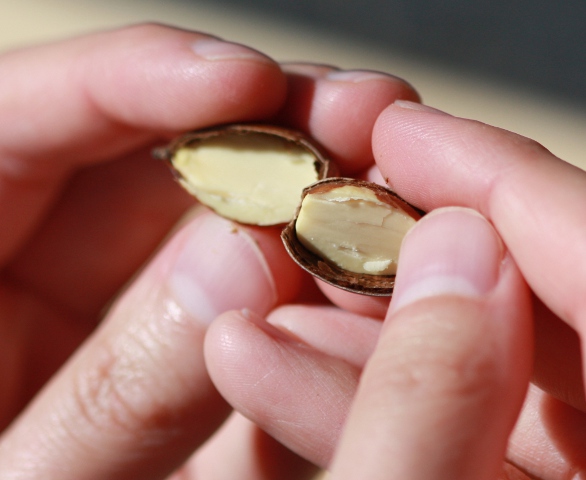
They taste fegging delicious! The meat is soft and smooth, like acorn, if you happen to have ever eaten acorn, har har. And sweet. I can't compare them to the chestnut flavor, alas, because my fancy expensive imported chestnuts turned out to be all dried up. That big yellow brainy thing is the chestnut nut-meat. They were sweet but too tough to bother with raw, and when I tried roasting them, they turned into toothbreakers. So, not a fair comparison.
Both chinkapin and chestnut have a shell that is more like leather than wood. Again, much like acorn. This makes chestnuts versatile, because they can be cut open with a knife. Perhaps that is what I needed to try with the chinkapin. As it turns out, they are too small for a nutcracker to open. Using the extreme wrong end of the cracker, I sent a few nuts zinging across the living room, and painstakingly squashed the remainder. You can see the slightly mangled nutmeats, above. A board and a rock would have been faster, and mangled them just as thoroughly.
After eating those, I cracked open a pecan. Three things struck me. "Wow, this shell sure is a noisy brittle pain." "This nutmeat is giant!" And "this tastes like sawdust." There actually was enough moist sweet flavor in those smaller-than-peanut chinkapins to put pecans to shame. And I love pecans.
Fascinating!
Saturday, November 27, 2010
Surprise!

Germination! Here is my first confirmed Allegheny chinkapin tree.

Ironically, this little guy is growing in the container that I let Gabe set up. I had given him the small nuts, and the molding ones, to keep him busy while I got the rest potted. There may be a dozen in here. But by the way the exposed roots looked, and the sorry quality of the nuts, I had been sure they were dead! I guess they like the shallow and cluttered conditions. Perhaps it reminds them of the way they would collect naturally on the forest floor.
My next challenge: did I give these plants enough room to grow between now and December? I only left a few inches of each container unfilled with dirt.
Better that I have to deal with overcrowded greens than no greens at all, I suppose!
Tuesday, November 23, 2010
Waiting for my Nuts to Grow

There isn't much to report right now. Twenty-some containers, each containing two nuts, are out in the garden. I won't know until the Spring if they survive.

Another twenty-odd containers, each with two nuts, hides indoors behind the sofa.

In theory these should sprout any day now, if I haven't killed them. But the jury is still out. They sat in a baggie in the fridge, partially germinated, for a couple of weeks, with nothing but a damp paper towel to sustain them. Then I got them into the container, but didn't get them adequately watered for most of a week, thanks to wrangling a toddler at the same time.
Supposedly chinkapin don't do well in soggy conditions, so I'm crossing my fingers.
So far, the weed seeds are germinating nicely in the indoor containers. I guess that's a good sign. I'll need to use the bacon tongs to pull those out, but in the mean time, at least something is growing.
More ominously, in the one container where I gave Gabe some of my extra nuts and let him play, I can see a couple of the partially-germinated nuts peeking out of the soil, and they appear to be rotting. But in another container where my hasty watering dislodged soil, I can see what looks like new roots. So, fifty-fifty chance?
Sunday, October 31, 2010
Chinkapin Propagation

After decades of breeding work, the American Chestnut Foundation is now making Castanea dentata nuts available that are likely to be resistant to the blight! There is hope! This news makes me glad in a profound way. But gads, the price tag is $350 per pair. No, I didn't displace a decimal point in that number.
But it's a good thing, I suppose, because I don't yet have enough experience to be growing such a critically endangered species. Those nuts are for arboretums and the Whitehouse and people who really really know what they are doing. The price should drop eventually as production goes up, and in the mean time, there are similar species that I could practice on, such as Chinkapin, Castanea pumila, pictured above. So, I ordered some.

And oh. Crap. I should have read up on these guys a little more. Sometimes, when conditions are right, they start germinating right on the tree. Unlike other seeds I have started over the winter, I don't have a few months to leisurely get them into containers. These little guys arrived already trying to grow.
So I posted a flier up at work explaining my need for containers, and entitled it "Help! My Nuts are Germinating!" My coworkers can't resist a good gag, so by the following day, my desk was covered in milk jugs and soda bottles.
(This prompted a discussion in which a male friend asked after my nuts, and I asked after his jugs, and we both walked off laughing our asses off. I love my workplace!)

The soda bottles, I cut like this.

And the milk jugs, like this.

This gives me maximum pot space in each jug type. With the milk jugs, it also allows me to hold the lid open easily with one hand, making filling easier.

In the Spring, I plan to cut the tops of the containers off, and continue to let the seedlings grow in the container they germinated in. Unlike the standard approach to winter sowing, I will not immediately be transplanting the seedlings. Each container gets only two nuts. One in each pot will be sacrificed next year.
This is me, using my fingers as a dibble.

And here is the final army of containers, ready to be sealed up with tape. The containers function as mini greenhouses. They will be left outdoors all winter, and with any luck, I will have more trees next year than I know what to do with.
I still have a lot more nuts, however. Hopefully my coworkers will continue to bring me plastic gifts.
Thursday, October 14, 2010
Scarlet Runner Beans

I decided to grow some scarlet runner beans this year in marginal locations around the garden where they wouldn't have the best conditions, but would have plenty of room to grow. Based on this year they have definitely earned a place in a garden next year. When they are young they are amazingly tender and flavorful. Probably among the best green beans I've ever eaten. As they get larger they lose their texture and flavor, but you are rewarded with large beautiful beans. We still have to try the beans I've collected in a meal, but even if they aren't good there the tender beans alone are worth the space and effort.
Monday, October 4, 2010
Gathering and Smashing

Yesterday, Chris got busy constructing a device to hold firewood (made from recycled lumber), and loading it up. While he did all of that manly lifting, I did some traditional women's work. . .

. . .shelling acorns! Yes, that's right, for eating. Humans around the world have eaten acorns as a staple for far longer than they have eaten today's cultivated grains. I had never tried acorns before, but I hated to see our tree's last crop wasted.
Behind me is the rest of the tree, all chipped up for mulch.

How to shell acorns: find round rock. Hit acorn.

This is what a bad acorn looks like. Silly me, I stored my first batch of acorns indoors in a sealed tupperware for a few days. This cause many of them to get yucky like this. Acorns need to be dried in the sun immediately, or perhaps soaked in water, or refrigerated.
Now this acorn looks yummy! Being a white oak, these acorns should be sweeter than red oaks, but I still found them to have an unpleasant raw flavor. The texture is lovely, though - soft like a chestnut, but less grainy.
I had to put down my rock and forage for more acorns to get the two cups of nutmeats that my acorn bread called for. Alas, the wildlife had cleaned up most of the nuts, and those remaining had been out in the rain, and were busily germinating. I was frustrated until it occurred to me to crack open a germinating acorn. Voila! Perfect nut meat. And of course: a living nut wouldn't be rotting, would it?

Two hours got me two measly cups of nutmeats, which felt even more pathetic in comparison to Chris' filled wood wrack. But oh, look at how much wood he has left to go! And I can't help him with the lifting, since I am pregnant. Sorry Chris!
Next: acorn bread!
Thursday, September 30, 2010
The Felling of a Grand Old Dame

Chris took this series of photos of our majestic white oak as it was cut down. This is the "before" image. I estimate the tree to be fifty feet high. A swing hangs from one mighty branch.

This maple was also to get a little trimming. A similarly-sized maple on the other side of the oak is being cut down as well.

The crane has arrived.

The crane, reaching over the house. The oak is the largest mass of green there behind the house.

This fellow directed the proceedings from my mowed meadow.

The first limb is removed. . .

. . .and hoisted. . .

. . .to the front yard, where it is revealed to be as large as an entire tree.

The limb is denuded of smaller branches, which are fed to the chipper.

The bald log is hoisted back over the house to the mowed meadow, where it is cut into firewood.
A quick count of tree rings show the tree to be seventy or eighty years old. But those samples were taken from twenty feet up. I would guess the age of the tree to be around a hundred. I try not to think of that as I look at these pictures.

I had been under the impression that oaks only produce acorns every four years, so I was surprised to see these all over the yard. As it turns out, oaks tend to produce a good crop every two to five years - two, in this case. Add to that that an oak doesn't even begin to produce acorns until it is at least twenty years old, and the tree's last desperate dispersal of nuts is even more poignient.
The squirrels have been busy planting them. I have collected a box of acorns to try cooking with, though I can't say I found the raw flavor to be appealing.

I had wondered how we would eventually get the ragged old swing down. Chris regrets not snapping a photo as the branch came in for a landing: one of the arborists hopped on the swing for a ride.

A professional tree-climber at work.

The top of the tree is hoisted.

And here is the trunk, topped with the arborist. They lopped it off just below the remaining fork, and left twenty feet of trunk standing, as we had requested, for the woodpeckers. The rest, they left for us as logs and mulch.
It pains me to kill a tree, but it had to be done, and these guys did a fantastic job of it. They also came in a whopping $500 lower than their $1500 estimate. So if you live anywhere near Foxboro, Massachusetts, and you need an arborist, call Tree Tech. May we never have to call on them again.
Tuesday, September 7, 2010
American Chestnut

A couple of weeks ago I took Gabe out with me to check on the progress of the American Chestnut Foundation's breeding program site at Idylbrook Field in the town of Medway. I can't tell you how happy it makes me seeing these hundreds of young Castanea dentata growing. This has got to be the single most important North American species, plant or animal, and here it is, held ever so precariously from going over the knife-edge of extinction.

Some photos of the leaves, because I'm a nut like that.

More leaves, this time with speckles. Is this due to stress from the drought conditions we have been experiencing? Are the trees heading into autumn already? Or, I shudder to think, is this evidence of the blight?
It looks like the blight manifests itself in cankers on the trunk of the tree, so I think these beauties are safe for now. Thank goodness. Here is some more information on the chestnut blight, if anyone is interested.
Anyway, on to another weekend, and another park. . .

Wait, you're kidding me. Really?

I'm at the Franklin State Forest, and they're here along the edge of the road, just outside the YMCA.

My hand, for scale reference.

The trunk of this one was maybe two inches in diameter at the base. I hope those aren't cracks. Cracks let the blight in.

But I guess it's a foregone conclusion that these little trees will be knocked down by the blight. These aren't young trees. These, almost assuredly, are the regrowth from the roots of trees that died to the ground a hundred years ago. I looked for stumps, but they must have rotted away long ago. These shoots will reach ten or fifteen feet in height, and the blight will wipe them out again.

These trees won't ever grow tall enough to produce offspring. But ironically, coppiced trees can live much longer than trees that grow normally. So long as growing conditions remain suitable, these guys could live for centuries like this.

It is with mixed feelings that I walk away from these little trees. Look, some worker has lopped one off here. I suppose it's not as obvious as smashing a stained-glass window. You have to be some kind of plant geek to recognise this tragically obscure tree. At least this window grows back, somewhat.
But let's end this post on an upbeat note, shall we? Lookee! Squee! Potentially blight-resistant chestnut seeds are becoming available to TACF members! I must look into that! Squeee!
Subscribe to:
Posts (Atom)


 Posts
Posts

